H O M E
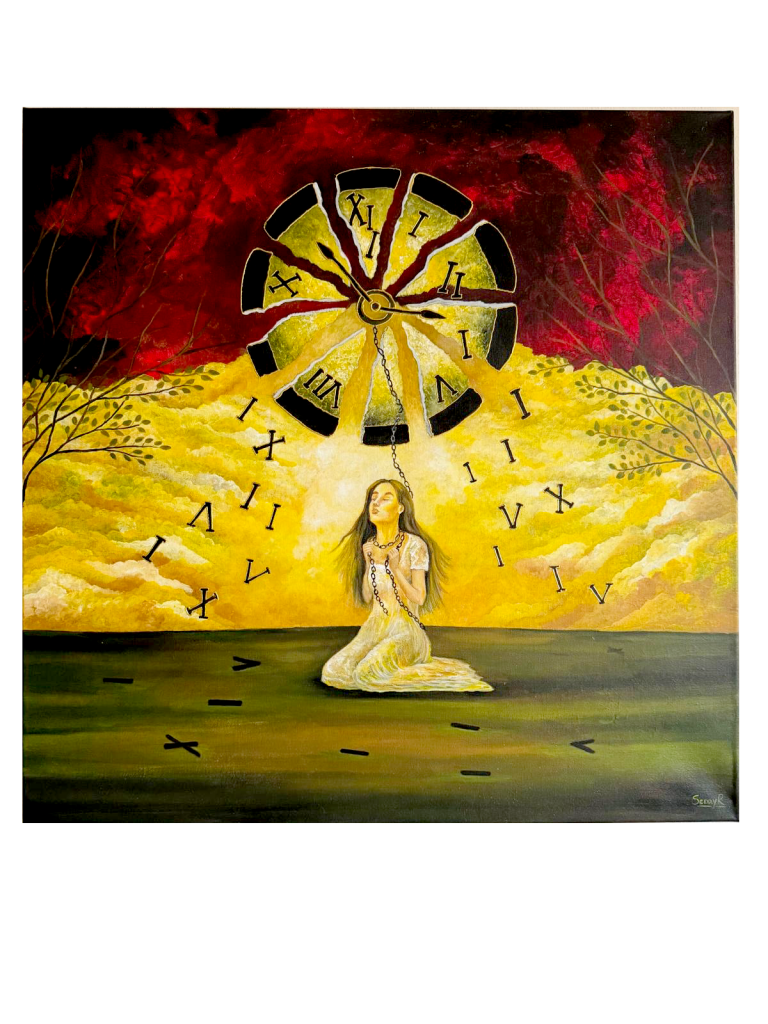
“Break the Time” – An Artistic Interpretation
The painting “Break the Time” by Shenay Ramada is a visual parable about humanity’s struggle with time — not as a mechanical measure, but as an inner force that restricts, pressures, and shapes human consciousness.
At the center of the composition stands a kneeling female figure, bound by a chain that connects her to a disintegrating clock above. Her body is subdued, yet her face is turned upward, illuminated by light. This contrast reveals the dual state of the human being: physically subjected to time, yet spiritually seeking liberation. The chain is not merely a symbol of captivity — it is also a connection, a reminder that time is a part of ourselves.
The clock is broken and fragmented; Roman numerals scatter and fall like heavy signs onto the ground. This destruction does not suggest chaos, but rather a rejection of linear time — past, present, and future as a rigid sequence. The artist seems to declare that true freedom begins when one “breaks” the imposed dimensions of time: the fear of being late, of missed opportunities, of the inevitable end.
The color palette reinforces this message. The upper part of the canvas is saturated with deep reds and blacks — symbols of anxiety, tension, and inner turmoil. Beneath them flows a golden-yellow light, reminiscent of sunrise or revelation. This is the realm of hope and awakening, where time loses its authority. The ground below is dark and heavy — the place where the numbers fall, where human life feels the weight of days.
“Break the Time” is not a call to escape time, but to transform our relationship with it. The painting speaks of inner liberation — the moment when a person stops living as a prisoner of the clock and begins to exist fully in the present. Shenay Ramada reminds us that time can be a prison, but also a door — and the key to it lies within us.
 Senay Ramada