H O M E
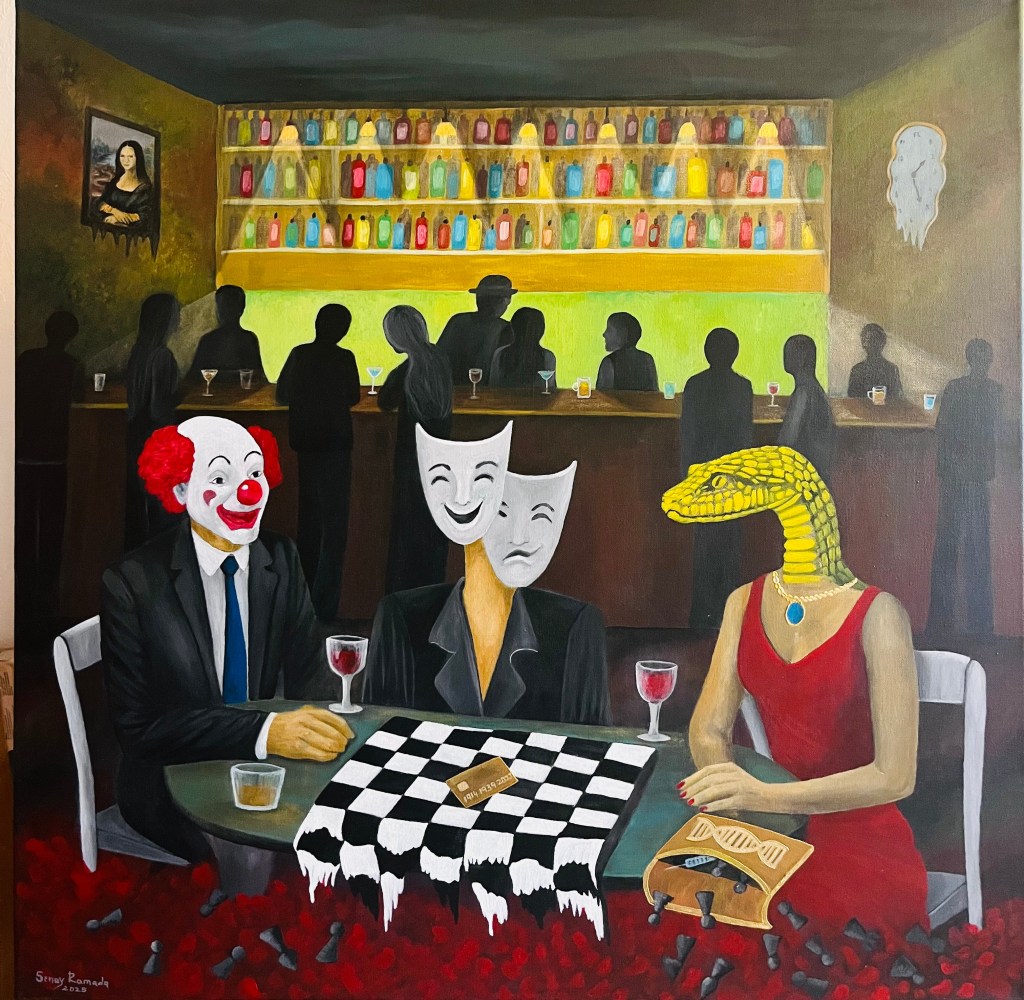
“Contemporary Parable” is an allegorical painting about contemporary society, where identity is fragmented, truth is masked, and morality is placed on a chessboard.
The scene unfolds in a bar — a metaphor for the world as a social arena. The shadowy silhouettes in the background are anonymous, their arrangement evoking Leonardo da Vinci’s “The Last Supper” — silent witnesses to a ritual in which meaning has been lost and community has been reduced to mere presence without participation. They observe, but do not act.
In the foreground, three figures concentrate the drama of choice. The clown embodies the voluntary mask — a smile as armor, a role adopted for survival. The figure wearing theatrical masks symbolizes the divided self, torn between social identity and inner truth. The woman with a serpent’s head represents primal instinct and temptation — the only character without a mask, because she does not conceal her nature.
The chessboard-patterned tablecloth is the central symbol of the painting: life as a strategic game in which every move carries consequences. Its melting edges suggest the collapse of rules and moral boundaries. The wine — simultaneously blood, truth, and oblivion — reinforces the sense of sacrifice and decision.
On one wall hangs the Mona Lisa, the eternal enigma of human identity, here reduced to a decorative quotation stripped of its sacred aura. Opposite it appears Salvador Dalí’s melting clock, a symbol of the disintegration of time, the relativity of reality, and the loss of orientation in the modern world.
A ghostly form lingers as a reminder of absent conscience — a pale presence that exists, yet no longer governs choice.
“Contemporary Parable” offers no answers. Instead, it places the viewer inside the scene and asks:
Which mask do we wear?
Who controls the game?
And is there time left for truth, when the rules themselves are dissolving?
 Senay Ramada